
Lessons of Practice and Presence
When Jeremy Narby first arrived among the Asháninka in the Peruvian Amazon, he came as a scholar, determined to study their knowledge of plants and their management of the forest. He thought he would observe, take notes, and understand through reason and analysis. He had little interest in their mythology or rituals—they seemed, to him, abstract or fanciful. Yet, almost immediately, he discovered that the very root of the Asháninka’s deep understanding of the forest, of plants, and of healing, was entwined with what he considered mythology. The spirits, the visions, the stories—they were not just tales, but integral guides to practical knowledge. Narby realized that to truly learn, he would have to put aside his purely rational lens and immerse himself in a world where wisdom was passed through presence, vision, and experience, not textbooks or lectures.
Witnessing Mastery in Action
One day, while walking through the forest with a man named Rafael, Narby mentioned that he needed a new handle for his axe. Rafael paused, nodded, and within moments had cut a small hardwood tree just steps off the path. With the precision of someone who had done this hundreds of times, he carved a handle that would outlast the axe itself. Twenty minutes later, the bulk of the work was done; another twenty minutes at home completed the adjustments. Perfect work, carried out by eye alone. Narby realized, with surprise, that he had always assumed axe handles came from hardware stores. Here, they were made from intuition, practice, and intimate knowledge of materials.

Rafael Chanchari Pizuri
The Asháninka taught by example, not by explanation. Children accompanied their parents in daily work, learning through observation and participation. Abstract concepts were met with skepticism; when ideas seemed impractical, a common phrase would be, “es pura teoria” — that’s purely theory. Two words recurred constantly in Narby’s interactions: practica and tactica — practice and tactics — necessities for survival in the rainforest.
Narby observed that the Asháninka’s love for practice extended even to their fascination with industrial technology. They asked him repeatedly about his tools—tapes, lighters, batteries, Swiss Army knives—and when he admitted he did not know how they were made, they were incredulous. He realized that while he knew how to use these objects, he had no understanding of their origins or inner workings, in stark contrast to the Asháninka, whose knowledge was holistic, intimately tied to the source, the materials, and the process. This revelation humbled him, highlighting how his academic training had fostered abstract knowledge, detached from the reality of how things came to be.
The Vibrancy of Vision and Spirit

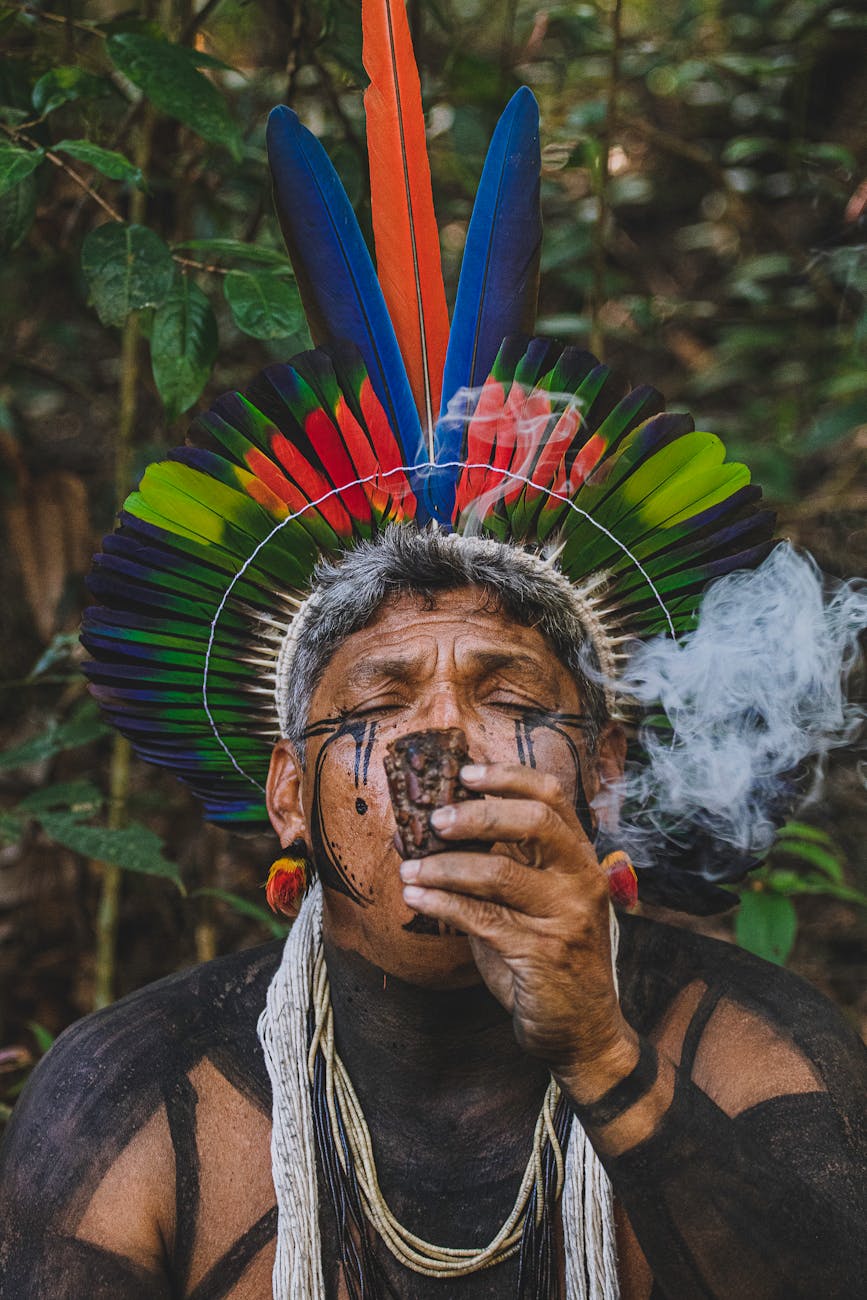
Narby spent time with the local ayahuasqueros-tabaqueros, shamans who communicated with the spirits of plants through ayahuasca and tobacco. He asked Carlos Pérez Shuma, his main consultant and experienced tabaquero-ayahuasquero, about the enormous snakes that appeared in visions and why they kept coming up. Carlos suggested that next time Narby should bring his camera and take their picture. Narby laughed, certain it was impossible to capture visions on film. Carlos insisted that it could be done because their colors were so bright.
Narby had never considered photographing hallucinations seriously — he expected only darkness. Yet the Asháninka considered visions produced by hallucinogenic plants to be as real as ordinary reality. This gentle challenge forced Narby to confront the limits of his Western perception, where understanding must be visible, measurable, and documentable.
Practical Knowledge in Daily Life
Narby’s immersion extended beyond observation. He experienced firsthand the Asháninka’s extraordinary use of plant medicine. Having suffered chronic back pain since the age of 17, he had consulted several European doctors who treated him with cortisone injections and heat therapy, but nothing provided lasting relief. He was therefore skeptical when Abelardo Shingari, known for his “body medicine,” proposed a cure using sanango tea during the full moon. The experience was intense: chills to the bone, cold sweat, loss of coordination, and brief, vivid hallucinations. Yet by the third day, Narby’s pain had disappeared and never returned. Experiences like this challenged his assumptions, showing that practical results often transcended his intellectual explanations.

Sanango is said to raise both physical and spiritual heat, which helps to purify the mind, body and spirit of toxic energies. Uchu sanango’s healing properties are extensive. One main area of focus is the central nervous system—it penetrates deep into the body’s nerves as well as throughout the musculoskeletal system, bringing alignment to the core structure of the body. It also directly affects the brain and neurons, leading to a “reset” of the neural network and its interconnections. Sanango is also known to improve one’s eyesight (i.e. enhancing physical and spiritual “vision”), enhance memory, cleanse the body and brain at the cellular level, help release toxins, and alleviate stress and tension. Sanango also has anti-inflammatory properties. Being a root medicine, sanango helps “dig into” and “root out” core issues that prevent one from living within one’s integrity.
Similarly, he witnessed cures using tobacco. A man named Sabino brought a sick baby to Carlos, who used two Peruvian cigarettes in a precise ritual — drawing smoke, sucking at a specific spot, and spitting out the illness. In mere minutes, the baby’s health improved. Narby struggled to reconcile what he saw with what he believed possible. To the Asháninka, these acts were grounded in spiritual-physical knowledge; to Narby, they initially defied scientific logic.
History, Mythology, and the Roots of Knowledge
Learning from Carlos also meant understanding the Asháninka’s history. Born in the Perene Valley in 1940, Carlos lost his parents to epidemics brought by colonists — waves of disease and displacement that decimated entire villages. Like many survivors, he migrated to the Pichis Valley with others of his people, seeking refuge deeper in the forest. There, he became president of the Association of Indigenous Communities of Pichis (ACONAP), dedicating his life to defending his people’s territorial rights and way of life. It was only after a snakebite that he reluctantly stepped back into semi-retirement in Quirishari.
His life story mirrored the larger struggle of the Asháninka. Colonization had not only taken lives and land but also waged a quiet war on their beliefs. Missionaries arrived claiming to bring light, yet in doing so, they cast deep shadows on the Asháninka’s spiritual world. They condemned ayahuasca and tobacco rituals as “works of the devil,” dismissing the maninkari — the spirits of the forest who taught through visions — as evil illusions. The forest that had always been their teacher was suddenly recast as dangerous and sinful.

Indigenous people in the Peruvian Amazon were enslaved by rubber barons into the 20th century.
Under missionary influence, many communities were pressured to abandon their ceremonies and healing traditions. Shamans were ridiculed or silenced. Generations grew up fearful of their own knowledge, hesitant to speak of visions or spirits. Yet beneath the imposed silence, the old ways survived — whispered in songs, remembered in stories, kept alive by healers like Carlos, who balanced respect for the church with devotion to the forest.
Through long conversations, Narby came to see how the Asháninka held their history in their landscape. Mythology, geography, and spirituality were inseparable. Their place names carried memory and meaning, born not from human authority but from revelation. When Narby asked Carlos about the origin of “Pichanaki,” he learned that its meaning had been revealed in visions to the ayahuasqueros-tabaqueros — healers guided by the spirits themselves.
“Aki,” Carlos explained, meant “eye,” referring to minerals found in the center of those places.
“Picha” represented animals in the surrounding hills — guardians of the forest.
Together, the name spoke of life, abundance, and balance — “the eye of Picha.” To the Asháninka, such names were not poetic inventions but living truths, received from nature through communication with the divine. As Carlos told Narby, “That is how nature talks, because in nature there is God, and God talks to us in our visions.”
For Narby, who had come seeking rational explanations, this was difficult to reconcile. Mythology, he had believed, was symbolic — something separate from fact. But among the Asháninka, myth and fact were one. Their visions, far from fantasy, were maps of understanding — guiding how they farmed, healed, built, and named their world.
Tobacco, Ayahuasca and the Ethics of Power
Tobacco and ayahuasca were central to Asháninka practice. Carlos explained that ayahuasca was the “mother,” and tobacco her child. Together, they formed the foundation of communication with the spirit world — one cleansing and purifying, the other grounding and protecting. These plants were not merely substances; they were living intelligences that carried life force and spiritual power.

Carlos told Narby that every plant had a mother — a guiding spirit — and that the mother of ayahuasca appeared as a great serpent. To the Asháninka, this was not symbolic. The snake was the primordial teacher, a being of immense wisdom and duality. It represented transformation — shedding skin, renewing life — and carried both healing and danger, creation and destruction. It was the same force that coursed through the jungle itself: powerful, coiled, and alive.
When the ayahuasqueros-tabaqueros drank ayahuasca, they encountered these immense serpents in their visions. The snakes revealed songs, medicines, and teachings. They also tested the heart of the seeker. A person approaching the brew without respect or discipline could be overwhelmed, even harmed. The snake’s knowledge, Carlos said, was sacred because it was exact — it gave what one was ready for and nothing more.
Carlos further explained that plants were like our grandparents — elders who enjoyed imparting their wisdom to those who approached them with respect. “They like to teach,” he said, “but you have to listen.” This view revealed a relational understanding of knowledge — one that was lived, felt, and shared rather than possessed.

For Narby, this was difficult to accept at first. His rational training could not easily reconcile the idea that intelligence might exist in plants, let alone that a snake could be a teacher. Yet he could not deny what he observed. The shamans spoke of these encounters with precision and consistency; their practices had measurable results. Their healing worked — not as metaphor but as experience.
Through this, Narby began to grasp that knowledge in Asháninka culture was relational and embodied, not abstract or theoretical. It was acquired through respect, humility, and direct communion — not through experimentation or analysis. The plants did not “belong” to anyone, nor could their teachings be bought or patented.
As Carlos once told him, “Truth is not for sale. Wisdom is for you, but it is for sharing.”
To the Asháninka, wisdom was a living current that flowed through all beings. It was not something to possess, but something to be in relationship with.
ZenFusion’s Reflection
There’s something profoundly human about fearing what we can’t categorize. Access to knowledge has always come with a price — not because knowledge itself is dangerous, but because it dissolves the walls we build to feel safe.

Ignorance is comfortable. It allows us to move through life believing we are in control, that the world fits neatly into our equations. But imagine if we truly knew — that every vibration, every thought, every leaf, every breath, is connected to an infinite network of energy and intelligence. Would we still cling to our small certainties?
Throughout history, those who dared to access knowledge through nature and energy — the so-called witches, shamans, mystics — were feared and persecuted. They were accused of dark arts, branded as agents of the devil. But in truth, what they practiced was also a form of science — an ancient one. They studied how things work, only through communion instead of calculation.
Both systems — the intuitive and the intellectual — carry light and shadow. With understanding comes responsibility. The knowledge that can heal can also destroy. The Asháninka know this — they walk the razor’s edge between creation and corruption. So do scientists who manipulate genes, atoms, and ecosystems. The difference lies not in the knowledge itself, but in the intention behind it.
Yin and yang — the eternal balance of opposites. The universe does not punish us for knowing. It only reflects how we use what we know.
The Asháninka’s way of learning is intuitive, rooted in trust and harmony. The Western scientific method, by contrast, relies on reduction and control. One dissolves the ego; the other often inflates it. One heals by restoring balance; the other tends to suppress symptoms for the sake of efficiency.
But perhaps both are incomplete on their own.
If we could bridge them — intuition with intellect, energy with experiment — we might finally see the full spectrum of truth. A world where science and spirituality walk hand in hand. Where humans, animals, and plants communicate in mutual respect, and progress doesn’t come at the cost of the planet’s soul.
Imagine that.
A civilization where being alive itself is a sacred, creative act.
Where knowledge is not power — but participation
Further Viewing and Reading for Curious Minds
If you want to go deeper into themes of plant intelligence, shamanic knowledge, and the intersection of science and spirituality, scroll down for recommended videos and books. For the books, simply click on the title that interests you — it will take you directly to its Amazon India page, where you can learn more and place an order.
Videos
Ayahuasca, Tobacco & Plant Teachers (Jeremy Narby interview)
This talk features Narby himself explaining how plants, ayahuasca, and tobacco act as teachers in Indigenous knowledge systems.
The Secret Language of Plants – Invisible Nature
A science-driven exploration of plant communication and responsiveness.
Ayahuasca | FULL DOCUMENTARY
A comprehensive visual journey into the ritual, cultural context, and transformative dimension of ayahuasca ceremonies.
Curandera | Ayahuasca Documentary (2025)
Focuses on an Indigenous practitioner’s path, highlighting how traditional healing knowledge persists in modern times.
Ayahuasca: Vine of the Soul (FULL DOCUMENTARY)
A dive into the cosmology and spiritual significance of ayahuasca, its symbolism, and its living power in Amazonian traditions.
Books
Intelligence in Nature: An Inquiry into Knowledge by Jeremy Narby
In this book, Narby explores the concept of intelligence within the natural world, examining how plants, animals, and ecosystems exhibit forms of knowledge and awareness. He delves into the idea that intelligence is not exclusive to humans but is a fundamental aspect of life.
Plant Teachers: Ayahuasca, Tobacco, and the Pursuit of Knowledge by Jeremy Narby with Rafael Chanchari Pizuri
This work presents a cross-cultural dialogue between Narby and Pizuri, a traditional healer, discussing the spiritual and medicinal roles of plants like ayahuasca and tobacco in Indigenous Amazonian cultures. The book emphasizes the reciprocal relationship between humans and plant teachers.
Shamans Through Time: 500 Years on the Path to Knowledge by Jeremy Narby and Francis Huxley
This anthology compiles writings from various shamans over five centuries, offering insights into their practices and worldviews. It provides a historical perspective on shamanism and its evolution.
The Healing Power of Rainforest Herbs: A Guide to Understanding and Using Herbal Medicinals by Leslie Taylor
This comprehensive guide explores over seventy rainforest botanicals, detailing their medicinal properties, historical uses by Indigenous peoples, and current applications. It serves as a bridge between traditional knowledge and modern herbal practices.
Mysteries of the Jaguar Shamans of the Northwest Amazon by Robin M. Wright
This book chronicles the life of Mandu da Silva, the last living jaguar shaman among the Baniwa people in the northwest Amazon. It offers an intimate look into the spiritual and healing practices of one of the region’s most revered shamans.
Singing to the Plants: A Guide to Mestizo Shamanism in the Upper Amazon by Stephan V. Beyer
This accessible study introduces readers to the ritual practices of mestizo shamans, focusing on their spiritual relationships with native plants and the use of ayahuasca in healing ceremonies.
The Psychotropic Mind: The World According to Ayahuasca, Iboga, and Shamanism by Jan Kounen, Jeremy Narby, and Vincent Ravalec
This collaborative work explores the experiences and perspectives of individuals who have engaged with psychoactive plants like ayahuasca and iboga. The authors discuss the insights gained from these experiences and their implications for understanding consciousness.
Ayahuasca Visions: The Religious Iconography of a Peruvian Shaman by Pablo Amaringo with Luis Eduardo Luna
This book showcases the visionary artwork of Pablo Amaringo, a Peruvian shaman, depicting the intricate and symbolic imagery encountered during ayahuasca ceremonies. It offers a visual insight into the spiritual experiences of Indigenous Amazonian cultures.
The Light Eaters: How the Unseen World of Plant Intelligence Offers a New Understanding of Life on Earth by Zoë Schlanger
Schlanger investigates the latest scientific research on plant intelligence, challenging traditional views and offering new perspectives on plant consciousness.
The Teachings of Don Juan: A Yaqui Way of Knowledge by Carlos Castaneda
Castaneda’s seminal work documents his apprenticeship with a Yaqui shaman, providing insights into the use of psychoactive plants in spiritual practices.
Ayahuasca Shamanism in the Amazon and Beyond by Beatriz Caiuby Labate and Henrique Carneiro
This collection examines the role of ayahuasca in shamanic traditions, exploring its cultural significance and contemporary use.
References
- Narby, J. (1995). The Cosmic Serpent: DNA and the Origins of Knowledge. New York: Tarcher/Putnam.
- Weiss, G. (1960s). The Cosmology of the Campa Indians of Eastern Peru.
- Harner, M. (1990). The Way of the Shaman. New York: Harper & Row.
- Davis, W. (1996). One River: Explorations and Discoveries in the Amazon Rain Forest. New York: Simon & Schuster.

2 Responses
Fantastic beat ! I would like to apprentice while you amend your site, how could i subscribe for a blog web site? The account helped me a acceptable deal. I had been a little bit familiar of this your broadcast provided vivid transparent concept
Thank you so much for your kind words! I’m really happy to know the articles were helpful to you.
At the moment, I don’t have a subscription feature on the website. I usually share all new articles and updates on the ZenFusion Facebook page.
You can follow the page using the link below, and that way you’ll see all new posts when they’re published.
https://www.facebook.com/zenfusioncom
Thank you again for your encouragement — it truly means a lot!